Research links
some scriptures to hostile acts
By Amy Choate-Nielsen
Deseret Morning News
Feb. 27, 2007
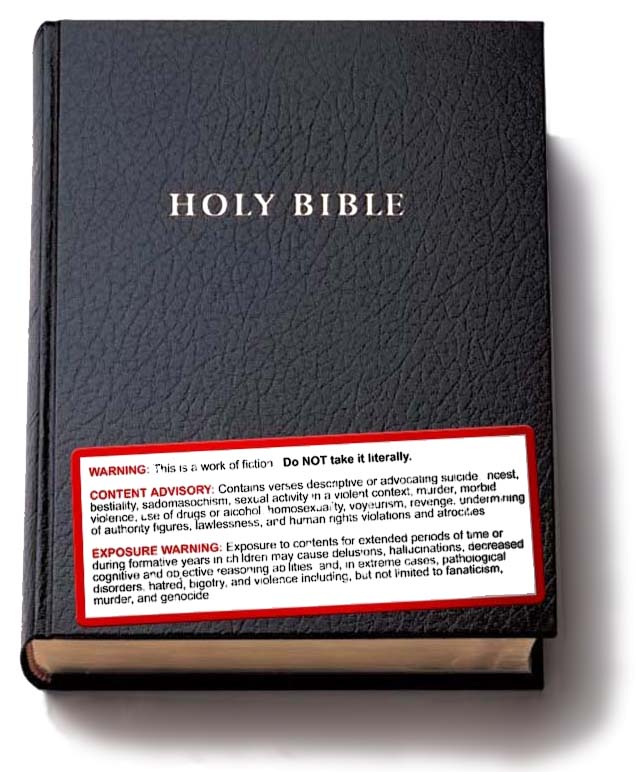
PROVO Utah — Chances are, not many people in Utah would like to
think of scripture as a violent medium that promotes hostility. But a
study of 490 students — 248 of them at Brigham Young University —
suggests a correlation between exposure to scriptural violence that is
condoned by God and increased aggression.
University of Michigan psychologist Brad Bushman,
BYU professor Robert
Ridge and three other researchers co-wrote "When God Sanctions
Killing," which will appear in the March issue of Psychological Science
magazine. Although the study points to a correlation between scriptural
violence and aggression, Ridge said the research is not meant to attack
scripture study.
"We were not saying that reading the scriptures is bad, but we were
pointing out that if a person was seeing that kind of (violent)
literature, it could have some negative effects," Ridge said. "We
weren't trying to find fault with religion or the scriptures or
anything, but when you think about terrorists and they say, 'God will
sit in judgment,' and they sometimes refer to a scripture, our question
was, 'Could that really make a person behave more aggressively?' And the
answer is, yes, it could."
About a year ago, Ridge recruited 95 male and 153 female
students from BYU — a private university in Provo owned by The
Church of Jesus Christ of Latter-day Saints — to participate
in the project. They were selected to represent a population
of people who are strongly religious. Ninety-nine percent of
the students reported having a belief in God and the Bible.
The students were given extra credit for their participation.
In addition to the BYU students, 110 male and 132 female
students from Vrije Universiteit in Amsterdam, the
Netherlands, participated in the study. These students were
chosen because they represented a more diverse population of
people with different religious backgrounds. Of the group, 50
percent said they believe in God and 27 percent said they
believe in the Bible.
To do the study, both groups of students were shown a passage
of scripture from the Old Testament that contained tales of
beatings, rape and murder. Half of the students were shown an
additional passage that included violent retribution as
sanctioned by God. The other half was not. The students who
were not shown the additional passage were told the story came
from an ancient scroll. The others were told it came from the
Bible.
by
Ken Smith
The world's
most complete compendium
of the Bible's most
embarrassing passages.With
hammerhead precision and pig-
iron wit,
this compact volume lays bare all the
sex,
gore
and lunacy that the Bible has to offer
.
Pick one up for a friend!
Members of both the religious and non-religious groups who
were exposed to the additional verse responded with greater
aggression in a subsequent test than did those who did not
read the passage.
In the test, participants were placed in groups of two. Each
person was given headphones and a "weapon" — a button that
would produce a noise frequency that could be as loud as a
smoke alarm. The students each pressed a button as fast as
possible for 25 trials and the slowest of the pair would
receive a blast in the ears. The winning button-pusher could
choose how loud to make the sound in the other person's ears.
Aggression was measured by the frequency with which the
winning students blasted their partners.
The study indicated that those with a stronger religious
background responded with slightly more hostility — and louder
blasts — than those who were not as religious.
Ridge says that indicates a correlation between aggression and
isolated violent passages.
The correlation also mirrors studies that show the
relationship between hostility and violent movies, music or
video games. The key difference is that if scriptures are read
as a whole and not taken out of context, the results can be
the opposite, Ridge says, as the overall themes of the Bible,
specifically, are peace and love.
"We're not saying that just in and of itself violent media is
uniformly bad but oftentimes there is no redeeming context to
it," Ridge said. "If one reads the scriptures with an
understanding of context, both historical as well as with a
(desire) to hear what God is trying to teach us, you can read
it in a different way. But if a person dives into (a violent
passage) without the context, you could probably get some
increased aggression."
Daniel Judd, BYU professor of ancient scripture, who was not
involved in the study, said he agrees with the importance of
understanding scriptural context. Taken by itself, a
scriptural passage can wrongly rationalize negative behavior,
he says. "You can use scripture to justify anything you're
looking for," Judd said.
Ridge received approval from BYU's institutional review board
before he conducted his test, but the board only serves to
make sure proposed research projects are scientifically sound,
not politically correct. Ridge said he had some trepidation
about how his report will be received, but he hopes people
will read the study before making final judgment.
As a highly religious university with a scriptural curriculum
requirement, the study is somewhat ironic in its setting. But
BYU spokeswoman Carri Jenkins says she hopes people won't hear
of the study and get the wrong idea. "Our concern is with how
people will perceive the conclusion,"
Jenkins said. "But like all research, it does need to be
studied carefully.
With
precision and pig-
iron wit, this compact
volume lays bare all the
sex, gore, and lunacy
that the Bible has to offer.
Robert Spencer
Robert Spencer delivers a simple,
easy-to-comprehend guide exposing
bloody teachings and the disturbing
facts surrounding the history of Islam;
it serves as an antidote against the
falsehoods surrounding the faith as
well as... (407
customer reviews)
Edited by Robert
Spencer
"Robert Spencer has assembled a collection
of documents devastating to PC myth and multi-
culturalists wishful thinking. Anyone concerned
about the dangers of politically motivated distortions
of Islamic theology and history should not miss this
explosive and enlightening volume."
(42 customer reviews)
JEFFREY RUBIN, Editor, Conservative Book Club
Ellen Johnson, President (973)
625-6900
Dave Silverman, Communications Director (732) 648-9333
Apr. 2 2007
ATHEISTS WARN
PROPOSED U.N. BAN ON "DEFAMING" RELIGION THREAT TO FREE SPEECH,
CHURCH-STATE SEPARATION
"This proposal amounts to an international 'blasphemy' statute, and
punishes those exercising a right to question and criticize religious
superstition..."
-- Ellen Johnson, President, American Atheists.
An Atheist civil rights group condemned Friday's passage at the United
Nations of a proposal for a global ban on "defaming" religion.
The measure, passed 24 -14 (nine abstentions) by the U.N. Human Rights
Council called upon governments to "take resolute action to prohibit the
dissemination including through political institutions and organizations
of racist and xenophobic ideas and material aimed at any religion..."
States are also asked to encourage "tolerance and respect" for religion,
and report on acts of violence or discrimination against religious
populations.
"One of the problems here is that religion and religious believers are
being singled out for 'special treatment,' " said Ellen Johnson,
President of American Atheists. "Atheists aren't mentioned, and we have
plenty of cases where inappropriate and aggressive religious
proselytizing, even physical coercion, is being allowed in schools, the
workplace and in government."
Johnson also warned that the resolution was vague and overly-broad, and
that criticizing or even questioning religious creeds is seen by many as
a form of "defamation."
"This amounts to an 'anti-blasphemy' statute that can punish anyone
exercising free speech," said Johnson.
The measure was supported primarily by Islamic countries. Dave
Silverman, Communications Director for American Atheists," noted that
the measure only mentioned Islam and Muslim minorities.
"Many of these countries have shabby records when it comes to human
rights and freedom of expression," said Mr. Silverman. "Even if all
religions were included in this dangerous proposal, however, we would
still oppose any attempt to punish people for expressing an honest
opinion about religion and what many of us argue is a superstitious and
un-enlightened point of view."
Silverman added that all concerned with freedom of speech, including
religious groups, should oppose the measure.
AMERICAN ATHEISTS is a nationwide movement that defends civil rights for
Atheists; works for the total separation of church and state; and
addresses issues of First Amendment public policy.
American Atheists, Inc. P. O. Box 5733 Parsippany, NJ 07054-6733 Tel: (908) 276-7300 Fax: (908) 276-7402
Australian scientist faces
excommunication from The Church of Jesus Christ of Latter-day Saints
Published Thursday, July 21st, 2005
The Associated Press
SALT LAKE CITY (AP) - An Australian scientist who wrote a book saying DNA evidence contradicts ancestry claims in the Book of Mormon faces
disciplinary action in a separate case that could bring excommunication from The Church of Jesus Christ of Latter-day Saints.
Simon Southerton told The Associated Press he's been ordered to a July
31 hearing before church leaders in Canberra, Australia.
Southerton's book "Losing a Lost Tribe: Native Americans, DNA and the
Mormon Church" uses DNA data to argue against Book of Mormon teachings
that ancient America's inhabitants descended from Israelites.
Yet Southerton, a plant geneticist in Canberra, faces charges of
adultery, not heresy. He acknowledges an affair five years ago, after
separating from his wife, but contends church authorities are using that
against him while the more difficult apostasy charge is "obviously the
major issue."
Southerton says church authorities never mentioned adultery when they
paid him a recent visit, instead bringing up his book, abandonment of
the church in 1998 (though he technically remains a
LONDON — Albert Einstein: arch rationalist or scientist with a spiritual
core?
A letter being auctioned in London this week adds more fuel to the
long-simmering debate about the Nobel prize-winning physicist's
religious views.
In the note, written the year before his death, Einstein dismissed the
idea of God as the product of human weakness and the Bible as "pretty
childish."
The letter, handwritten in German, is being sold by Bloomsbury Auctions
on Thursday and is expected to fetch between $12,000 and $16,000.
Einstein, who helped unravel the mysteries of the universe with his
theory of relativity, expressed complex and arguably contradictory views
on faith, perceiving a universe suffused with spirituality while
rejecting organized religion.
The letter up for sale, written to philosopher Eric Gutkind in January
1954, suggests his views on religion did not mellow with age.
In it, Einstein said that "the word God is for me nothing more than the
expression and product of human weaknesses, the Bible a collection of
honorable but still primitive legends which are nevertheless pretty
childish."
"For me," he added, "the Jewish religion like all other religions is an
incarnation of the most childish superstitions."
Addressing
the idea that the Jews are God's chosen people, Einstein wrote that "the
Jewish people to whom I gladly belong and with whose mentality I have a
deep affinity have no different quality for me than all other people. As
far as my experience goes, they are also no better than other human
groups, although they are protected from the worst cancers by a lack of
power. Otherwise I cannot see anything 'chosen' about them."
Bloomsbury spokesman Richard Caton said the auction house was "100
percent certain" of the letter's authenticity.
It is being offered at auction for the first time, by a private vendor.
John Brooke, emeritus professor of science and religion at Oxford
University, said the letter lends weight to the notion that "Einstein
was not a conventional theist" — although he was not an atheist, either.
"Like many great scientists of the past, he is rather quirky about
religion, and not always consistent from one period to another," Brooke
said.
Born to a Jewish family in Germany in 1879, Einstein said he went
through a devout phase as a child before beginning to question
conventional religion at the age of 12.
In later life, he expressed a sense of wonder at the universe and its
mysteries — what he called a "cosmic religious feeling" — and famously
said: "Science without religion is lame, religion without science is
blind."
But, he also said: "I do not believe in the God of theology who rewards
good and punishes evil. My God created laws that take care of that. His
universe is not ruled by wishful thinking, but by immutable laws."
Brooke said Einstein believed that "there is some kind of intelligence
working its way through nature. But it is certainly not a conventional
Christian or Judaic religious view."
Einstein's most famous legacy is the special theory of relativity, which
makes the point that a large amount of energy could be released from a
tiny amount of matter, as expressed in the equation E=MC2 (energy equals
mass times the speed of light squared).
The theory changed the face of physics, allowing scientists to make
predictions about space and paving the way for nuclear power and the
atomic bomb.
Einstein's musings on science, war, peace and God helped make him world
famous, and his scientific legacy prompted Time magazine to name him its
Person of the 20th Century.
LITTLE ROCK, Arkansas (AP) --
Since Tony Alamo's start as a California street
preacher more than 40 years ago, the self-styled
evangelist's story has been colorful and checkered.
When his wife died of cancer, Alamo claimed she would be
resurrected and kept her body on display for six months
while their followers prayed. It would be 16 years
before her body was returned to her family.
For a time, his elaborately painted denim jackets were a
must-have in Hollywood, but sales contributed to tax
problems that landed him in prison for four years in the
1990s.
Alamo was charged but not convicted of other crimes,
including child abuse. Now the 74-year-old is accused by
former church members of abusing children and running an
organization in which girls who just reached puberty can
marry. Agents raided his southwest Arkansas compound on
Saturday and placed six girls in state custody.
In an interview Monday, Alamo spoke of the allegations
with a mix of denial and defiance, saying he never
promoted sexual abuse but that he believes there's a
mandate from the Bible for young girls to marry.
"In the Bible it happened. But girls today, I don't
marry 'em if they want to at 14-15 years old. Because we
won't do it, even though I believe it's OK," Alamo said.
In an interview on Saturday, he had said that for girls
having sex, "consent is puberty."
On Monday he bristled at descriptions of his
organization as a cult, saying enemies want to cast him
as a "weirdo for preaching what the Bible says."
People who have left Alamo's organization say they have
witnessed older men marrying girls who just reached
puberty. The U.S. Attorney's Office said in an e-mail
that was inadvertently sent to media last week said
agents expected to find children ages 12-14 who had been
abused and that they expected to file charges. The
e-mail said agents believed child pornography was being
produced at the compound in Fouke.
Alamo also denied creating any pornography.
"They (government agents) have got six of our girls in
custody. Little girls. They probably disrobed them. I
mean it's the most filthy bunch of devils that I've ever
heard of," Alamo said.
As for former followers making the allegations, Alamo
said, "I've kicked a lot of people out of the church and
they'll say anything to get back at me."
He suggested efforts to gather evidence against him will
only bring more people to his ministry, noting that
daily traffic on his Web site has grown more than
10-fold, to more than 1 million hits, since the raid.
"They're really making us famous," he said with a laugh.
Alamo, who now lives in California, said he still
preaches daily. He first bought land in Arkansas in 1975
for a complex near Alma and from there grew to own a
number of businesses.
Fashion was his best-known business. His painted denim
jackets were worn by celebrities for a time and even now
are offered for hundreds or even thousands of dollars on
the Internet. Alamo's Web site features a picture of Mr.
T wearing one.
Alamo went to prison for tax evasion after the complex
was raided in 1991. He fled with his followers before
the raid, taking with him the body of his wife, who had
died nine years earlier.
In order to be released from his sentence in 1998, Alamo
followed a judge's order to return Susan Alamo's remains
to members of her family.
And Alamo's property had been raided once before, in
1988 in Santa Ana, California, where state officials
came to seize three boys and return them to their
fathers' custody.
An 11-year-old boy told police that Alamo directed four
men to strike him 140 times with a wooden paddle as
punishment for minor offenses. Alamo briefly faced a
child-abuse charge but a prosecutor directed that the
count be dropped, citing a lack of evidence.
In 1991, Alamo was acquitted on a charge that he
threatened to kidnap a federal judge.
Alamo claims to be unique among Christian preachers
because he was born a Jew and had a "supernatural
experience" through which he became a born-again
Christian.
"I am a completed Jew," he said, though he added that he
had never believed in Judaism.
Alamo's anti-Catholic bias is evident as he speaks. He
claims the White House is in league with the Vatican,
which he says also controls the United Nations.
He said being a Jew gives him special insight.
"We wrote the Bible. I don't want these stinking
gentiles in Rome telling me what it says. They don't
know," he said.
Under state law, investigators have to make a court
filing after a search warrant is executed that details
what the search found. But Circuit Judge Jim Hudson said
the document would be kept under seal because of the
juveniles involved.
The six girls taken into state custody will require a
hearing if they remain with the state on a long-term
basis but there was no indication Monday that a hearing
had been set.
Arkansas Department of Human Services spokeswoman Julie
Munsell said the children were taken from the compound
because they were "in harm's way or in imminent danger."
She said the state is trying to identify the children's
parents.
As for what would inspire people to follow Alamo or
other charismatic leaders, there is no single or easy
answer, said David Bromley, professor of religious
studies at Virginia Commonwealth University.
"These groups vary, and when they are at the hot stage,
there is intense commitment. When people leave, when you
have that kind of intensity, they tend to be rejected by
the group and they tend to be quite hostile when they
leave," said Bromley, who is writing a book on why
people join such movements.
Bromley said that such organizations may not be as
strong as they seem.
"These groups are much more diverse than they appear on
the surface. You have people who look and talk alike,
but when you find out who the members are, you find the
levels of commitment are enormously different," Bromley
said.
"It looks pretty solid to you from the outside but you
find out people have different reasons for being there
and that half are on their way in and half are on their
way out," he said.
Alamo would not discuss how his organization operates
beyond saying it accepts donations. He said he has
workers who keep the books and pay the bills, including
his $70,000 salary.








 Addressing
the idea that the Jews are God's chosen people, Einstein wrote that "the
Jewish people to whom I gladly belong and with whose mentality I have a
deep affinity have no different quality for me than all other people. As
far as my experience goes, they are also no better than other human
groups, although they are protected from the worst cancers by a lack of
power. Otherwise I cannot see anything 'chosen' about them."
Addressing
the idea that the Jews are God's chosen people, Einstein wrote that "the
Jewish people to whom I gladly belong and with whose mentality I have a
deep affinity have no different quality for me than all other people. As
far as my experience goes, they are also no better than other human
groups, although they are protected from the worst cancers by a lack of
power. Otherwise I cannot see anything 'chosen' about them."